



Beyond the Warehouse: How Advanced Automation Creates Impact on Your Entire Value Chain
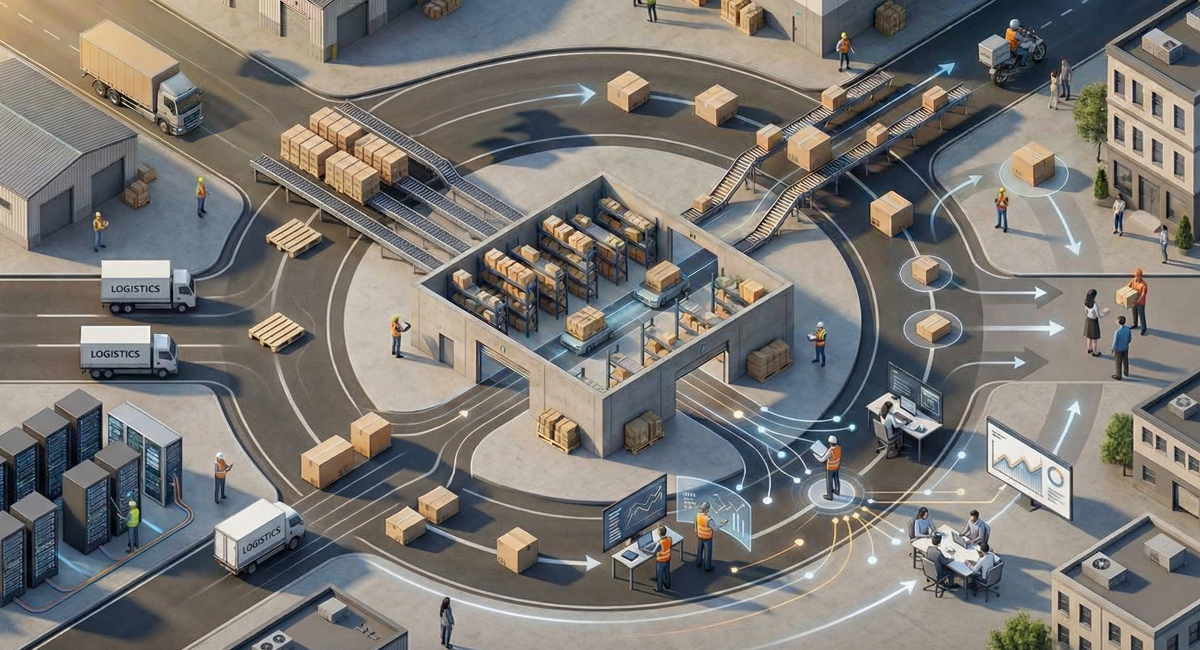
Warehouse automation goes far beyond improving warehouse operations alone. When thoughtfully designed and implemented, advanced automation creates a ripple effect across the entire value chain, impacting suppliers, operations, people, and ultimately customers.
This is because the warehouse is not an isolated function. It sits at the crossroads of supply, production, distribution, finance, HR, and customer experience. Any improvement or disruption within the warehouse directly influences how the entire organization performs.
Inventory as a Strategic Asset
Inventory management is often the first area where the impact of advanced warehouse automation becomes visible. By enabling accurate, real-time inventory tracking, automation provides full traceability of stock levels, batches, and expiry dates. This allows companies to manage inventory based on facts rather than estimates, which brings several benefits:
- Better purchasing decisions based on actual demand
- Reduced overstocking and lower working capital tied up in inventory
- Minimized waste from expired or obsolete products
Beyond cost control, inventory visibility directly supports sales strategy. Clear insight into stock levels and expiry dates allows sales teams to prioritize what to sell, plan targeted promotions, and avoid pushing products that do not require immediate movement. For example, short-shelf-life items can be promoted proactively, while long-shelf-life products can be sold more strategically.
Additionally, this visibility reduces the risk of stockouts and missed sales opportunities by enabling companies to:
- now exactly what is available at any moment
- Identify products approaching expiry to sell proactively
- Improve product availability, customer satisfaction, and service levels
In this way, warehouse automation transforms inventory from a static operational concern into a dynamic business lever that directly supports sales performance and overall value chain efficiency.
Generating New Revenue Streams
Warehouse automation can create new opportunities for companies beyond traditional operations. Automated warehouses can be partially subleased or branded as a third-party logistics (3PL) service, opening new business verticals without requiring prior 3PL experience. Automation ensures that the system itself handles complex processes, making it easier to offer 3PL services efficiently and reliably.
The benefits are both tangible and intangible:
- Enhances customer experience through faster, accurate, and reliable fulfillment
- Protects brand reputation by reducing errors and improving service levels
- Builds trust and confidence with current and potential partners
- Generates new revenue streams by subleasing warehouse space or offering additional services
- Increases market competitiveness as brands are more likely to partner with automated warehouses over manual ones
Empowering People & HR
Warehouse automation transforms both HR management and employee experience. Warehouses are highly resource-intensive operations, and automation reduces dependency on large manual workforces, especially temporary or third-party labor during peak seasons. This lowers hiring pressure, improves workforce stability, lowers error rates caused by untrained personnel, and allows HR teams to focus on building skilled, long-term capabilities rather than constantly managing manpower shortages.
In addition, advanced Warehouse automation positively impacts the quality of work across the entire organization. When employees, from operators to leadership, benefit from safer, more structured, and technologically advanced environments. This strengthens engagement and a deeper sense of belonging to the company, creating a positive ripple effect on overall organizational performance.
Automation moves teams away from repetitive, low-value tasks toward more meaningful work, boosting engagement, job satisfaction, retention, and overall organizational performance.
Data as the Backbone of Better Overall Company Decisions
Advanced warehouses are data-driven by design. Every movement, scan, and transaction generates real-time data that feeds planning, forecasting, and decision-making across the entire business.
This data improves inventory accuracy, reduces safety stock, and supports smarter purchasing decisions. Finance teams gain clearer visibility into working capital and ROI. Leadership benefits from fact-based insights rather than assumptions. Automation turns the warehouse into a reliable source of truth for the entire organization.
In a nutshell, when approached strategically, automation strengthens operational performance, improves financial outcomes, enhances employee experience, and enhances customer satisfaction. It transforms the warehouse from a cost center into a competitive advantage, quietly but powerfully impacting the entire business.