



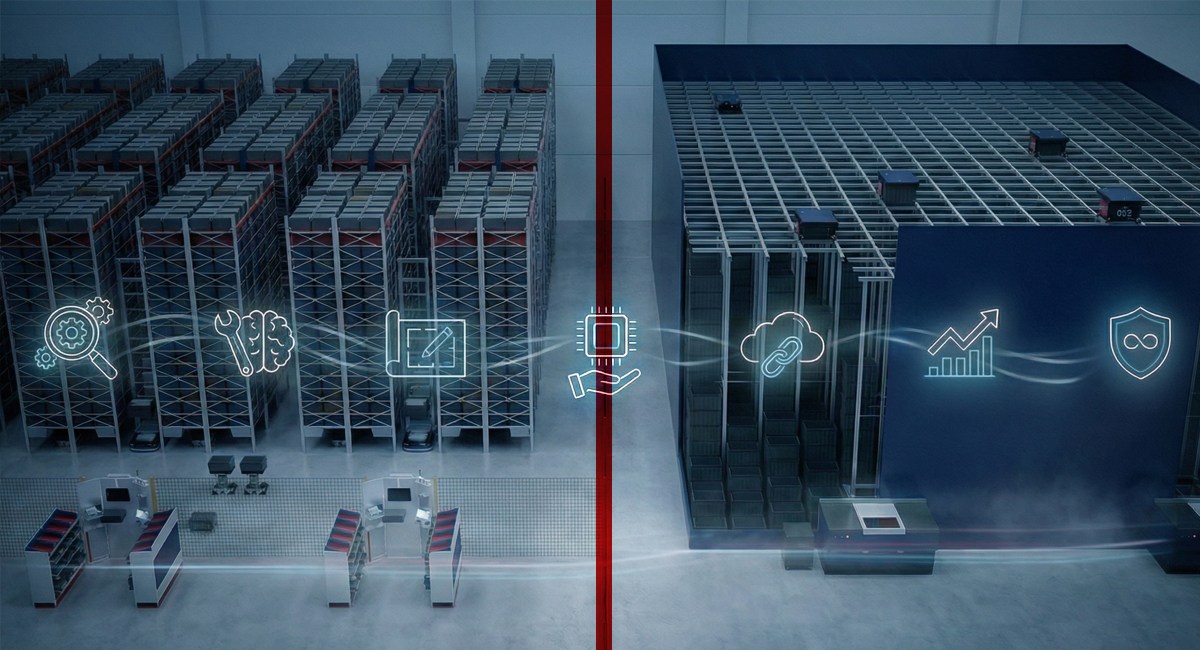
Warehouse Automation in 7 Uncompromisable Steps
When companies rush into automation -- driven by urgency, labor pressure or market trends, they tend to jump straight to selecting robots or software, skipping important steps in the planning phase. This leads to results opposite of what was expected, creating added inefficiencies and unexpected disruptions later.
Successful warehouse automation is not robots and latest technology purchase only. It is a detailed planning process, where every phase matters. At RAXS, we have summarized them into 7 equally important steps that companies should follow to avoid costly consequences later.
1. Data and operations Analysis:
A reliable automation solution can only be born from a deep understanding of real operations. This first step is about analyzing the customer’s data and warehouse reality, not taking generic assumptions. It includes detailed data analysis of customer raw data, site visits, as well as discussions with the operations teams on the ground and other stakeholders. It’s essential to examine how the warehouse actually works not how it’s assumed to work, and also consider other factors, such as:
- Business-specific constraints
- Future growth and scalability
- Anticipated changes in consumer behavior
- What end customers will expect tomorrow, not just today
All data and information must be cross-checked and validated. Only when operations and data are fully understood can a solution begin to be born.
2. Real Problem Identification and Solution Development:
Automation fails when companies try to solve the wrong problem. A sharp Diagnosis is key. Is the issue throughput? Accuracy? Space utilization? Labor dependency? Scalability? Or is it a process design issue that automation alone cannot fix? This step focuses on clarity. Defining the real problem ensures that automation is applied where it adds value, rather than masking deeper inefficiencies.
Once the problem is clear, a concept solution is developed. This phase includes layout optimization, process sequencing, storage and picking strategies, and clear interface points between people and systems.
3. Solution Design Sizing, and Planning:
The solution design sizing takes into account the customer warehouse layout but also the analyzed data. Solution sizing is a very important step in the design phase to determine the right amount of equipment needed to meet the current and future operational requirements. The design planning is even more critical, especially in brownfield projects. Installation and solution phasing must be carefully coordinated with the customer to minimize disruption and integrate new systems without disturbing ongoing operations. This is where an experienced team makes the difference.
Furthermore, during this planning phase, a detailed discussion around future growth and CAPEX phasing is essential. This allows future expansions to be built into the design, enabling the company to phase its CAPEX over time without needing to implement the full solution from day one.
It’s also important to assess project feasibility, evaluate Return on Investment (ROI) and Return on Objectives (ROO), to ensure the solution delivers strong financial viability with clear expectations. An experienced and trusted warehouse integrator must advise companies on this throughout the design phase to support informed and sustainable investment decisions.
4. Selection of the Right Technology and the Right Brands:
Only now does technology selection truly make sense. With operations understood, the problem defined, data analyzed, and the warehouse designed, it’s time to select the right type of robots, evaluate different brands and systems, and choose the right fit to the developed solution. Robotics, software, and automation systems must be selected based on operational reality, budget constraints, and long-term growth, not trends or preferences.
5. Integration, Software, and Performance Delivery:
Automation is not only equipment; it is orchestration. Once systems are selected, the focus shifts to integration, especially the software layer. A strong Warehouse Control and Execution Software (WCS/ WES) is essential to synchronize and orchestrate automated processes with the existing manual ones, from inbound to outbound. Equally important is integrating the solution into the company’s existing ecosystem to avoid operational disruption.
Projects must be delivered against defined KPIs. Performance matters more than installation. Deep understanding of the local market, regulations, and operational culture is critical at this stage, and often underestimated.
6. Ramp-Up and Stabilization:
Automation does not reach peak performance on day one. The ramp-up phase is where real success is achieved. Teams work hand-in-hand with the customer to:
- Fine-tune the system
- Calibrate machines
- Train operators
- Adjust based on real operational behavior
Automation is not an “out-of-the-box” product. It is a tailored solution that requires learning, adjustment, and stabilization. Performance is tested, KPIs are proven, and the system is supported until it reaches its expected operational level.
7. Long-Term Support:
Automation is a long-term investment, and sustained performance depends on continuous support. Accompanying customers throughout the entire lifecycle of the solution, providing on-site support, preventive and corrective maintenance, and remote assistance are vital.
Warehouse automation systems are designed to last at least 15-20 years, which makes long-term service capability essential. True partnership goes beyond delivering equipment; it means ensuring reliability, performance, and adaptability over time.
In brief, when steps are skipped, automation projects suffer and everyone wonders why. When the process is followed, automation becomes a powerful enabler of efficiency, scalability, and resilience.
Supported by a strong supplier network and multi-level integration expertise and technical support, RAXS helps safeguard your operations for the long run. Let’s Talk about YOUR warehouse!