



Why More Warehouses Are Struggling Despite Heavy Automation Investments
For many industrial and logistics leaders across the Middle East, the pressure on warehouse operations is becoming impossible to ignore. Order volumes are increasing. There is shortage in manpower availability. SKU complexity is growing. Customer expectations are accelerating. Industrial land is becoming more expensive and harder to secure. At the same time, businesses are expected to move faster, operate leaner, reduce errors, improve service levels, and remain resilient in an increasingly unpredictable market.
Yet many warehouses are still operating with models built for a different era.
For decades, warehousing relied on familiar manual systems and mechanized solutions: forklifts moving through wide aisles, traditional ASRS systems, fixed conveyors, static racking occupying large footprints, and labor-intensive workflows carrying much of the operational burden. While these models supported growth for years, they are now creating operational bottlenecks for businesses trying to scale in a faster and more demanding environment.
Today, the challenge is no longer simply about storing inventory or even automating them. The challenge is about how efficiently, accurately, and strategically warehouses can support the entire business and enable future proof operations.
Across the region, companies are realizing that continuously adding more labor, more forklifts, more mechanization or more warehouse space is no longer a sustainable answer. The real estate equation alone is becoming difficult to justify, particularly in strategic urban and industrial locations where expansion opportunities are limited and costly.
This is where the new generation of advanced warehouse automation is changing the conversation.
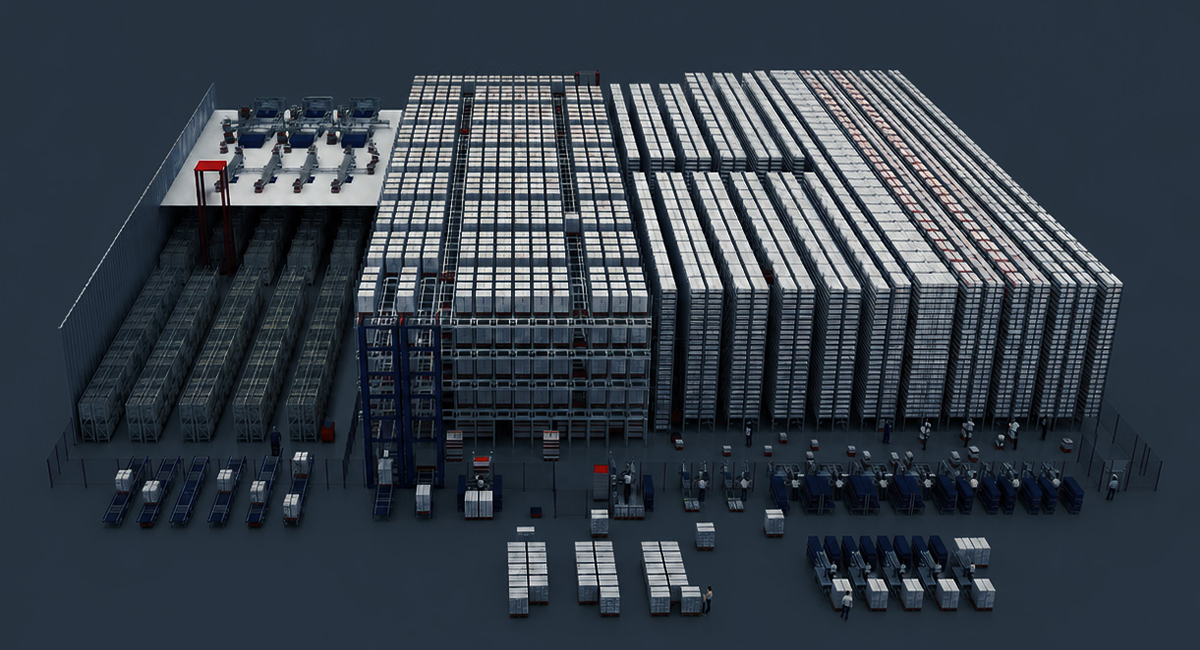
Technologies such as 4-way storage systems, robotics fulfillment systems, 3D robotic sorting, Autonomous Mobile Robots (AMRs), and software-led workflows are enabling businesses to dramatically increase storage density, improve throughput, and reduce operational inefficiencies without continuously expanding their footprint or compromising on flexibility.
Robotics systems can now utilize full warehouse heights, significantly increasing storage capacity within the same facility. At the same time, advanced automation reduces the need for wide operating corridors, allowing businesses to recover valuable floor space and optimize inventory density.
For decision-makers, this translates into something highly tangible: more operational capacity, faster movement, better use of assets, and lower long-term operational costs. But the pressure businesses face today goes beyond space optimization.
As warehouses become larger and operations more complex, the cost of operational inefficiency becomes far more visible. Picking errors, delayed fulfillment, safety incidents, inventory inaccuracy, disconnected systems, and inefficient workflows all directly impact profitability, customer satisfaction, and operational continuity.
This is why robotics and smart automation are increasingly becoming a strategic operational decision rather than simply a technological upgrade.
However, one of the biggest misconceptions in the market is believing that purchasing advanced machinery alone solves the problem. It does not.
Many companies investing heavily in warehouse automation without thorough planning and proper technology benchmarking, run in significant risks and discover later on that systems are not communicating properly, workflows were not redesigned to their optimal, teams were not prepared for the operational shift, solution is not flexible enough to cope with business fluctuation or software layers cannot orchestrate the movement of goods effectively across the facility.
The real challenge is integration and data-driven solution design.
A modern warehouse is not a collection of advanced technologies. It is a connected ecosystem where robotics, storage systems, software platforms, operational workflows, and people must function together seamlessly and designed with the right level of flexibility and modularity to adapt to business changes
That is why successful warehouse advancement begins long before equipment selection. It starts with understanding material flows, analyzing the operational data, identifying bottlenecks, forecasting growth, defining the right integration and designing around the realities of the business rather than around the appeal of and the expectations from a particular technology.
The companies seeing the greatest operational gains today are not necessarily the ones adopting the latest technology. They are the ones implementing the right technology, in the right way, for the right operational reasons.
There is no universal automation formula. Every warehouse operates differently. Every industry has different movement patterns, service expectations, operational constraints, and growth trajectories. The most effective solutions are those designed around operational reality, not technology trends.
As the Middle East continues to evolve into a faster, more interconnected, and strategically critical logistics hub, warehouse performance will increasingly shape business competitiveness.
The future will not belong to the companies with the most machines. It will belong to those capable of building smart warehouses that are integrated, adaptive, data-driven, and operationally aligned with the realities of their business and designed around their current and future goals.
If you are ready to move beyond isolated automation and explore how intelligent orchestration can advance your warehouse performance, RAXS helps you design data-driven, future-ready warehouse solutions tailored to your operational reality. Let’s Talk About YOUR Warehouse!